Episode Transcript
Welcome to the Making of you. I'm Alexandria, founder of the Mastery Project and Your Transformation Hub. And this podcast is dedicated to the whys and ways to transform the mundane into the magical, doable into enjoyable, successful, and purposeful, all while becoming the architect of your own life.
So, let's dive in. Today we're looking at five ways and whys Leonardo da Vinci cheated death.
Okay, so let's get right into this. Number one. Well, did he really cheat death?
Now, okay, you got me on a technicality, but what I want to say is, yes, if he were alive today, physically, he would be 574 years, but he is alive in our greater consciousness. So what do I mean by that? Well, my number one is that Leonardo did some pretty magical and amazing things in order to be raised to the collective consciousness of our species. So to have an enduring memory with us all and to create a vibe, a degree of resonance, a degree of personal consciousness and mastery that he is just as memorable or relevant or known today than he was, perhaps more so than he was in his lifetime. So my number one is, okay, he's not alive and well, you know, living in SW7, but he is alive and well in our consciousness.
And that is the indication of the great creative mastery that can bring lives, bring people together, really help us and remind us of what our true infinite potential really is.
So what did this illegitimate vegetarian, a little bit geeky youth, what did he do? What were the choices he made in order to be able to create this incredible resonance and incredible creative mastery?
Well, my number two is that Leonardo da Vinci really, really invested in his creative connection. All right, he, from an early age, was of course, encouraged as well, but he chose to look at the opportunities in his life, and he didn't say, hey, I'm going to highlight being illegitimate, or I'm going to highlight being a bit geeky or a little bit of a country bumpkin. I'm actually, first and foremost going to invest in my heart, mind alignment. Now, anyone who listens to my podcast, they know that is a very big thing for me, that we balance 100% of our resources by working with not only our hearts, but also our minds.
So Leonardo's biggest source of inspiration was his connection to everything.
He did not see himself as a victim. He did not see himself as separate. He saw himself as infinitely connected.
So how was he going to use this channel? Well, he knew to be in his heart center, and he knew that he was not only passionate, but he would also dedicate to quiet communion. As he saw it. So from an early age, he would ramble around the countryside and he would start to apply that wonderful observational skill into his art and into his ability to channel his passion and his take, his perception of all what was going on around him.
So not only did he listen to his heart and spend huge waking hours exploring that inner dimension calmly, with great focus, he also would then make a plan as to, of course, how that was going to be actualized in his daily life.
So he in his mind would say, right, I'm going to write a list of what I want to achieve, Do I want to do sketching, do I want to do painting, Do I want to be looking at the equations and the mathematics, the engineering, whatever he was choosing, he would be in that flow and in that zone. And when he was growing up, he believed most certainly that he had divine parents.
So on one hand he had God, and he never wanted to disappoint God. And on the other hand, he had Mother Nature, all right? And so he believed that Mother Nature would show him the way and would help him understand in what she was creating, a way to create anything and the way to harness his infinite potentiality.
So that's my number two. Leonardo worked to refine, enrich and strengthen his heart, mind, alignment.
Okay, number three. So what else did he do? Well, Leonardo was always adventuring and he knew his adventure started within. But then, of course, he would take that adventure and move forward.
So he was always exploring, and he started that in his childhood by exploring the lands around his father's estate. As I've mentioned, he was illegitimate and his father came from a relatively well off notary, so a legal counsel profession. But Leonardo knew that he did. He was on the adventure of his life because being illegitimate, he wasn't ever going to be able to follow in his father's footsteps.
So he created his divine parentage. He was in a very loving family, he was nurtured. He was treated in his childhood as an equal with the other children.
But he did know that he was going to need to learn skills, invest in his uniqueness.
And my number three, one of the most important skills Leonardo had was to keep his vision expanding so always to be connected with that infinite flow and then as a result, focus that infinite flow into material representations such as paintings, drawings, mathematical equations, engineering opportunities.
So he combined the big picture and his capacity to focus.
And as he explored his environment, he would take huge risks, all right? He was never worried about failing. So for a lot of people, the fear of mistakes can be what stands between them and harnessing their infinite potentiality.
So Leonardo would say, hey, I've just perhaps learned how not to do it. Or I have simply taken another step on that beautiful creative journey to enrich my experience.
So my number three is adventure, leaps of faith.
Leonardo had a lot of Sagittarian energy in him. And so he was really willing and open to go on that journey of life and to see every creative pursuit that he channeled through that he was inspired about every aspect of that was part of that journey. So he didn't go, that's bad, that's good. He simply chose and he kept honoring his inner creative flow.
Now, a lot of great people in modern times have said, it's really good to have a notebook.
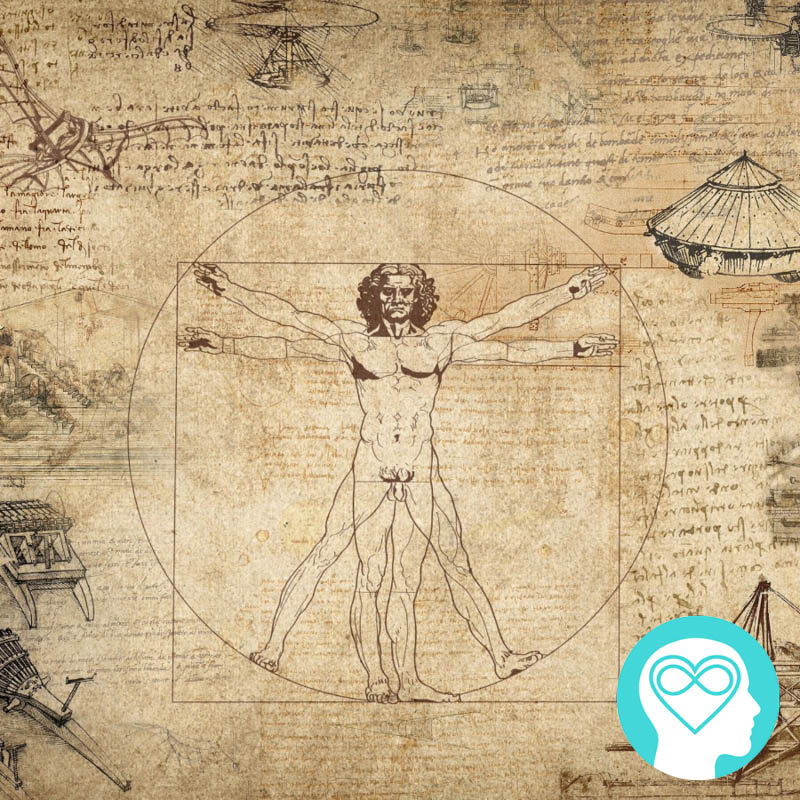
Sir Isaac Newton, Richard Branson. A lot of people say, carry a little notebook with you because when that beautiful inspiration hits, you do need to make notes. And so that's what Leonardo did industriously with over 7,000 pages in his lifetime in his journals.
And you can see from the craziness of it, he was constantly embracing his creative channel. He was writing down, whether it was shopping lists in his notebooks or great designs for weaponry or ways to approach sketching and to faithfully represent the physical form. It was all in like a spherical download or all directions. It was creativity everywhere.
So Leonardo didn't hesitate to record that amazing journey in his journals.
All right, number four.
So Leonardo definitely had that sag energy of exploration. He also had that being a rebel with a cause without conflict.
So he had a lot of ability when he was focusing his energy. But also a lot of that rebellion went into his creativity.
Now, Leonardo did find himself imprisoned in his life in his 20s.
And he didn't stop creating. He didn't fear that imprisonment. He went inward to say, that's my infinite freedom. And always being connected got him through that period, which was quite shocking and dark for him. But while he was there, what did he do? He said, create, create, and often and never stop creating. And so he drew a design for busting down the door, for breaking through the prison walls and the door. So he was busy even when he was imprisoned.
And he didn't want to be part of the status quo, not because he thought that it was particularly bad. He knew life was pretty on the edge in his times, constantly facing war, plague, famine, you name it.
But Leonardo said, if you want something better, then create it.
So he questioned the status quo. And he was always willing to say, hey, I need to be open minded and open hearted and I Do need to find out through my own personal inquiry what really works for me. If I'm going to leave a memory in the minds of men, I truly need to know myself from being willing to ask myself, myself, the big questions, some of them, the hard questions, and also to learn from every experience, even if it's shocking, even if it's difficult.
So it might shock us today that Leonardo did not necessarily perceive himself as a painter. His great aspiration when he was in his twenties was to become a renowned engineer.
But one of the most important elements of his rebellion was he wasn't doing it to get famous. He wasn't doing it to hustle with the rich of his era, the Medicis. He was doing it because he wanted evolutionary ideas to flow out. He wanted to find alternatives and to understand how to build a new paradigm, which we now call the Renaissance. But he was simply saying, hey, I don't need to be told when it's safe by experts to be myself or to enter into a new paradigm belief or to build. Build this. I need to go out and explore the options for myself and build it as I go. And so his rebellion was definitely in the channeling of his creativity, not in the fighting of what was in his life at his time.
So Leonardo was now, and he was constantly in that flow of his creative journey and never felt he was without resources in the sense of he was always connected. Did he have tough times as an artist? Yes, he did. Did he manage money? Well, not so much. But Leonardo knew that his creative connection was endless.
Okay, so my last point today, number five, what did Leonardo do with his new paradigm?
Well, he confirmed that life is always going to be unsafe. All right. A lot of his ideas, as we know, with this mirror script, he kept very private and personal.
He was the last person to court the type of controversy in his day that would cause persecution and even death.
So what he believed in was be a rebel with a cause without conflict. Always remember that charm, that a life of beauty, a life of being in cooperation. Collaboration was always going to be the way to move forward, because he wasn't an island, he wasn't a man on his own. He was definitely an artist who wanted to be with the people, who wanted an audience, and who wanted to have the relationships that would be able to show off his mastery. So my number five is, I don't think we can ever be too idealistic about Leonardo. He himself would say, particularly from his anatomy drawings in his later life, that, you know, life was very visceral to him. It was incredibly passionate. It was incredibly interesting.
But it was also that he said, you've got to join in with it, all right? And you've got to understand that quality is key. And my number five is that not only did Leonardo see everything as a co creation, but he also sought relentless quality. And that's why he's often criticized for not having that many finished works. But for him, it was about the quality and refinement of a single idea. And so that's why I believe he didn't necessarily manage to finish a lot of his homework, but he was getting to it in all of his beautiful diaries and all of his notebooks.
So I'd just like to finish today. If you do get the opportunity to go to the Uffizi in Florence, then I think you're going to see the exact example of what Leonardo achieved. When you go into the room with his paintings, you're going to see the awe, adoration that he sought to convey in his artwork. And you're going to see it in the people and on the faces, as everyone does gasp at his true and faithful brilliance in his own creative mastery.
Okay, well, it's been my great pleasure to talk about Leonardo today. I hope these insights have helped you on your creative journey and on mastery and the infinite potentiality that's inside of you, getting connected and being inspired to do so.
If you like this content, then please don't hesitate to like and subscribe on your chosen platform. Or you can go direct to Source and come and Visit us at YourTransformationHub.com and look at all the other free resources and also beautiful resources that you can use to build your infinite creative journey in your perfect way and celebrate your uniqueness. I'm Alexandria. Thank you very much for joining me. It.